HumanTech - Smart German Solutions
12
In the third, slow healing phase, the bone is reconstructed until reaching his final
load-bearing characteristics.
The time required for the three phases of healing time is called osseointegration
time and describes the time in which the bone substance links to the implant
surface in a sufficient and permanent efficiency.
ADONIS ® Exclusive has an optimized and reproducible surface-topography. The
relation between surface-topography and successful osseointegration has been
studied in the last three decades intensively and is well described today.
Beside the surface-topography, the osseointegration of the implant can be
improved through chemical coatings on the surface. The moderately rough
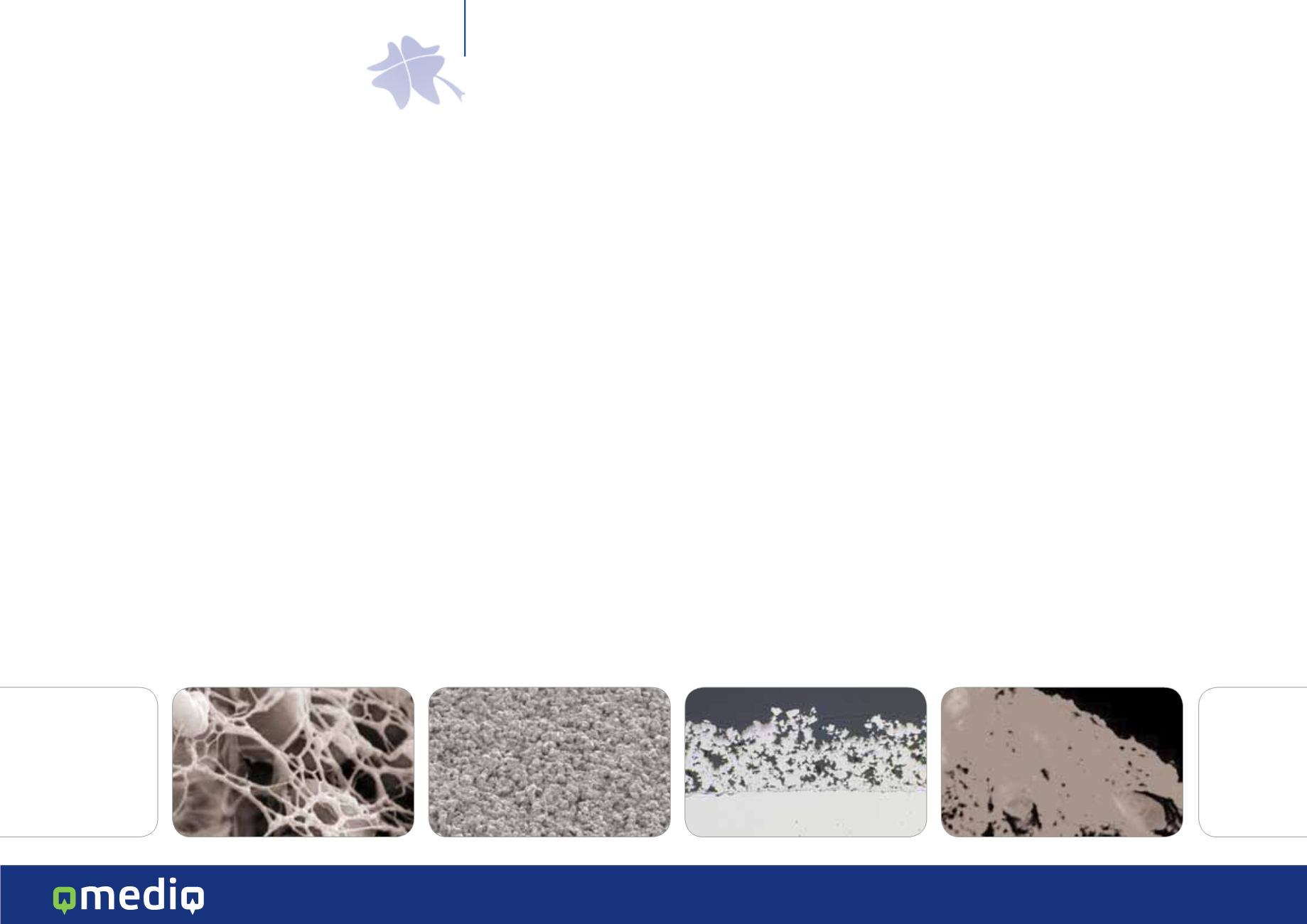
suface (Fig. 14 - „HENIAPORE-K“) of ADONIS ® Exclusive leads to a better bone
adherence.
HENIAPORE-K has been developed in order to optimize the implant surface in a
way, fast and postoperative adherence of young bones is encouraged (Fig. 15). A
review of clinical- and animal studies of Shalabi et Alvi affirms this statement.
Actually the vacuum-plasma-injection-procedure used for ADONIS ® Exclusive
is the most successful method in creating biocompatible surfaces. Due to this
very extensive manufacturing process an optimum wettable implant surface is
conserved while preserving the same surface topography.
The osseointegration can be accelerated through the improved wettablity and there
The implant surface has a big importance for anchoring the implant and for the
implant compatibility at the interface implant / adjacent tissue.
The success and speed of osseointegration are significantly influenced by the
surface of the implant.
Using an ideal implant surface the biological responses between implant and
bone can be optimized, and thus an earlier functional loading of implants can be
achieved.
Immediately after introducing the implant there are induced complex biological
processes between the surrounding tissue and the implant surface. The bone- and
wound healing can be divided in 3 phases.
During the first and most important healing phase, the first blood contact builds a
fibrin network (Fig 8) on the implant surface. This is connected with the aggregation
of thrombocytes and blood coagulation.
The hereby emerging blood coagulum is an important matrix for the invasion and
migration of osteogene cells to the implant surface and thereby plays a deciding
role for wound healing and osseointegration.
The osteogene cells differentiate at the implant surface and activate the building
of new bone through edifying a bone specific extracellular matrix (collagen) on the
implant surface.
On the next step there is built a mineralized boundary surface. This is equivalent to
a thin collagene-free coat on one osteon outer side in the natural bone tissue.
Osseointegration ADONIS
®
Exclusive
Fig. 13
Fig. 14
Fig. 15
Fig. 16
HumanTech - Smart German Solutions
12
In the third, slow healing phase, the bone is reconstructed until reaching his final
load-bearing characteristics.
The time required for the three phases of healing time is called osseointegration
time and describes the time in which the bone substance links to the implant
surface in a sufficient and permanent efficiency.
ADONIS ® Exclusive has an optimized and reproducible surface-topography. The
relation between surface-topography and successful osseointegration has been
studied in the last three decades intensively and is well described today.
Beside the surface-topography, the osseointegration of the implant can be
improved through chemical coatings on the surface. The moderately rough
suface (Fig. 14 - „HENIAPORE-K“) of ADONIS ® Exclusive leads to a better bone
adherence.
HENIAPORE-K has been developed in order to optimize the implant surface in a
way, fast and postoperative adherence of young bones is encouraged (Fig. 15). A
review of clinical- and animal studies of Shalabi et Alvi affirms this statement.
Actually the vacuum-plasma-injection-procedure used for ADONIS ® Exclusive
is the most successful method in creating biocompatible surfaces. Due to this
very extensive manufacturing process an optimum wettable implant surface is
conserved while preserving the same surface topography.
The osseointegration can be accelerated through the improved wettablity and there
The implant surface has a big importance for anchoring the implant and for the
implant compatibility at the interface implant / adjacent tissue.
The success and speed of osseointegration are significantly influenced by the
surface of the implant.
Using an ideal implant surface the biological responses between implant and
bone can be optimized, and thus an earlier functional loading of implants can be
achieved.
Immediately after introducing the implant there are induced complex biological
processes between the surrounding tissue and the implant surface. The bone- and
wound healing can be divided in 3 phases.
During the first and most important healing phase, the first blood contact builds a
fibrin network (Fig 8) on the implant surface. This is connected with the aggregation
of thrombocytes and blood coagulation.
The hereby emerging blood coagulum is an important matrix for the invasion and
migration of osteogene cells to the implant surface and thereby plays a deciding
role for wound healing and osseointegration.
The osteogene cells differentiate at the implant surface and activate the building
of new bone through edifying a bone specific extracellular matrix (collagen) on the
implant surface.
On the next step there is built a mineralized boundary surface. This is equivalent to
a thin collagene-free coat on one osteon outer side in the natural bone tissue.
Fig. 13
Fig. 14
Fig. 15
Fig. 16
De Mossel 11a, 1723 HZ Noord-Scharwoude |


